Deep Dive Into the World of Sourdough Starter
Tips for Making Sourdough Starter
Don’t use an airtight container for your sourdough starter. Instead, use a loose covering to keep stuff out while allowing it to breathe. I love these jars for mine.
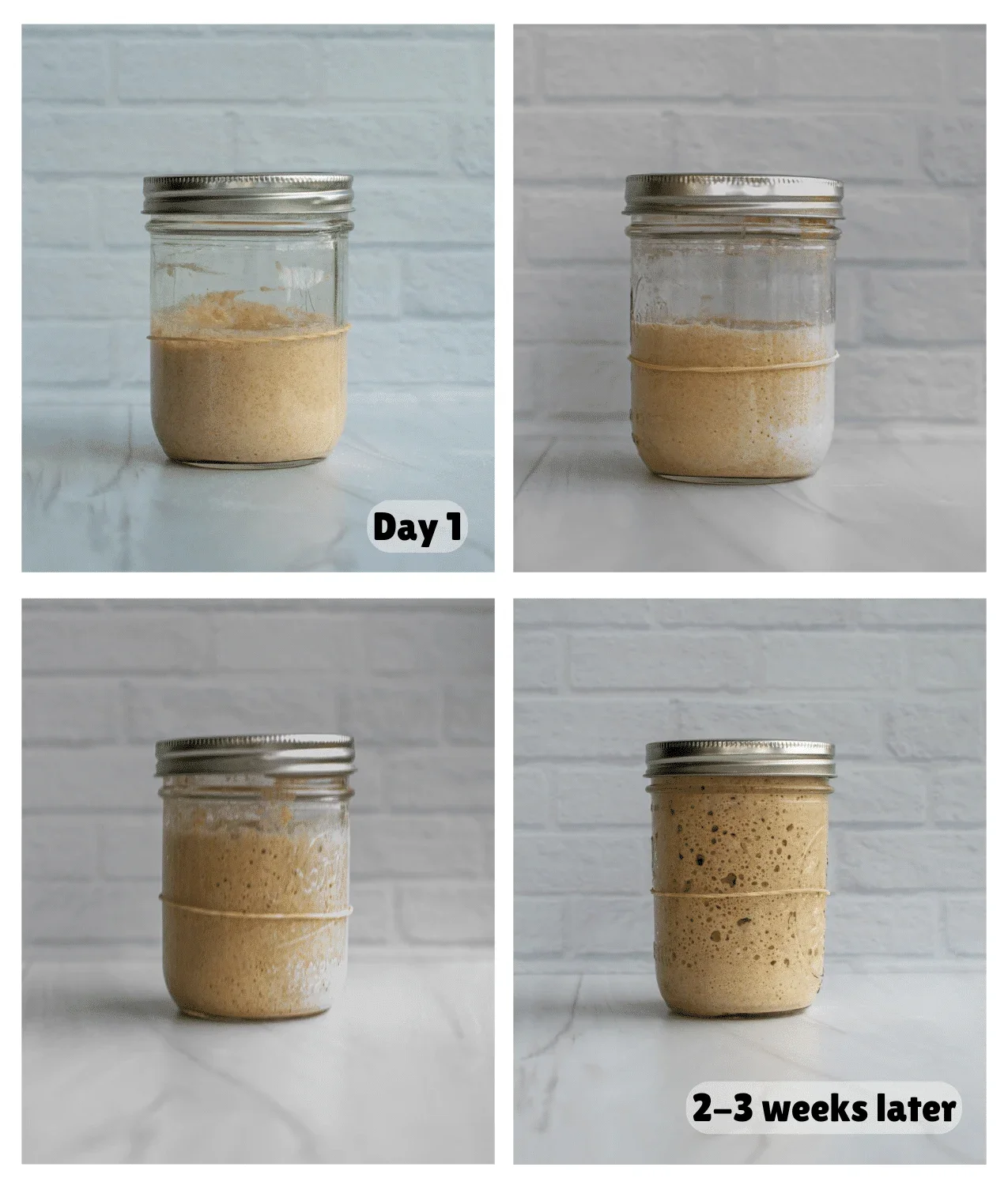
Making a new sourdough starter from scratch takes time, so be patient with yourself! Not sure when your starter is ready? I walk you through how to tell if your sourdough starter is ready to use here. One of my favorites way to test your different types of sourdough starters is with the float test.
Check out my post on maintaining and caring for a sourdough starter for more information.
How often should I feed my sourdough starter?
That totally depends on how often you are going to use it.
Say you are going to use your starter to make pancakes every morning, or english muffins or french toast. You can leave your starter out on your counter and just feed it every 12-24 hours.
I do not use my starter every day. I use it a few times a week, so what I do is keep it in the refrigerator in a bowl with an airtight lid or glass lid.
To illustrate, say that it is Friday, and on Saturday, I want to make pancakes. I will pull my sourdough out of the fridge on Friday and add some flour and water to the bowl, mix it up, and leave it on the counter with a tea towel covering it until Saturday morning.
Once I am done making pancakes on Saturday, and if I am not planning on using my sourdough starter until next week, I will feed it and leave it on the counter for 8 hours, then cover the bowl with an airtight lid and leave it in the refrigerator until next Friday.
However, let us say that I am planning on using my sourdough starter again on Sunday to make cinnamon rolls, then I will just feed the sourdough starter and leave it on the counter until Sunday.
When you leave sourdough on the counter at room temperature, the yeast will again be nice and active, and it will become bubbly sourdough starter.
Feeding a sourdough starter in the refrigerator
When you put your starter in the refrigerator, it puts the starter on pause, so you do not have to feed it as often because the yeast will relax and they do not need much sustenance. You can kind of think of it like a bear hibernating in the winter.
When the sourdough starter is in the fridge, it does not need to be fed as much as it does when it is on the counter. On the counter, it needs to be fed daily, but in the fridge, it only needs to be fed once a week.
You can even switch back and forth between the refrigerator and the counter if you use it sporadically.
If you use the starter every day, leave it on the counter. When not using it for two weeks, leave it in the refrigerator.
How much flour and water should I feed my sourdough starter?
Sourdough starters are really resilient. I have had mine for 11 years now and I never measure the flour and water. I just add enough to make the starter the consistency of thick pancake batter.
It’s not something I worry about, and it is a very happy, healthy sourdough starter.
Should you bake sourdough straight from the fridge?
This will depend on the type of recipe. Many no-wait recipes that call for discard will have no problem at all using a starter straight from the fridge.
But for other recipes, like bread, for best results I suggest taking it out of the fridge, feeding it, and allowing it to be nice and active before using it. This usually takes about 4–12 hours.
My sourdough is really thick and pasty — is it supposed to be like that?
No, it is not. If your sourdough starter is really thick, then just add a little more water until it is the consistency of thick pancake batter.
In the “How to Make Sourdough Starter” blog post, I give you the guideline of a 1:1 ratio of flour to water. However, that is just a guideline.
The real ratio depends on what type of flour you are using. If you are using an all-purpose flour, then you can get away with a smaller amount of water, but if you are using a whole grain wheat flour, you may need more water.
The basic principle is that some flours soak up water more than other flours, so the best way to find out how much flour to water you need is to just play around with it.
How do you store your sourdough starter?
When you are feeding you starter, you will leave it out on the counter where it can get a little bit of air, so you might cover it with a thin tea towel or something else that is not air tight. Cover for a few hours before putting it back in the fridge.
However, when it goes in the refrigerator, you are going to want to use something airtight. I personally keep my starter in a 2.5 quart glass bowl, and I cover it with a silicone lid. This is what I have always done.
Is it okay to put my sourdough starter away unfed?
I do not usually like to put my sourdough starter away unfed, but I am not saying I haven’t done it and still worked out just fine.
Once, after I made pancakes on Saturday morning, I put my sourdough starter straight into the fridge without feeding it first. I didn’t feed it at all until the next Friday when I pulled it out to feed it again in preparation for Saturday morning pancakes, and it was totally fine.
My starter taste really sour. How can I make it so that it does not taste as sour?
Your starter may have a little bit of a smell if it hasn’t been fed in a while, and your cooking projects will taste a little more sour to reflect that.
So if you want to avoid the super sour sourdough taste, you might just need to feed it more often and not let it sit out on the counter as long.
However, if you are sort of intolerant to grains, you are at least going to want to let it sit out for 24 hours to do all the fermenting work.
Do you know how to make gluten free sourdough starter?
Yes, after much experimentation I successfully created a Gluten Free Sourdough Starter and shared all the steps in this post here.
Why is sourdough starter much healthier than just regular flour?
This has to do with the grains and the fermentation. A lot of people today cannot tolerate grains. For the most part, a lot of people have given up grains and they are going gluten free and grain free.
I am not a doctor or a food expert, but I can tell you what I know about it.
Outside of a grain, there is a protective layer called phytic acid. That phytic acid is very incompatible with your body absorbing and digesting those grains.
When you ferment those grains, the fermentation process takes care of that pre-digesting work for you.
It makes the grains, and the nutrients in them, more easily accessible for your body to recognize and use without having to go through those original steps of breaking down the phytic acid. This process can be very taxing and difficult for your body.
Plus, fermentation just makes the nutrients more readily available. What was locked up inside the phytic acid in the grain, the outside of the bran, is now available for your body to use.
A lot of the vitamins that are in the grain are not actually doing you any good until fermentation unlocks them.
A lot of the time, people who cannot tolerate grains find that they can tolerate sourdough starter if it has at least sat out on the counter for 24 hours.
What is the difference between sourdough discard and starter?
They technically are the same thing. The difference is when a recipe calls for discard or active sourdough starter.
Discard refers to an unfed starter, or a starter that was fed, had risen, and is needing fed again but isn’t being used. It is also a term used when people toss out starter before feeding. At this point, I never discard any of my starter because of the frequency I use it in many recipes that call for just “discard“.
Active, on the other hand, is when it has been fed and has had time to get nice and bubbly.
Blog post from Farmhouse on Boone